The History of
Tenuta Villa York
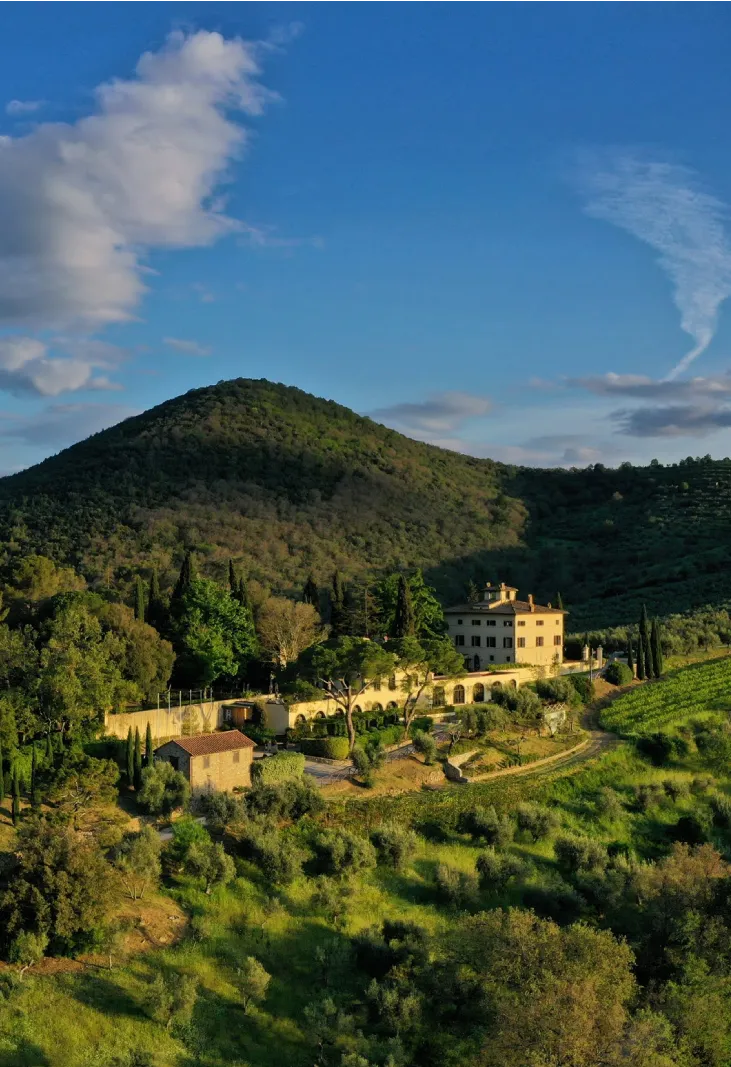
Villa York has an ancient history, probably dating back to medieval times, but its current structure is the result of interventions that took place over later centuries.
The historic residence is located in what is a privileged position, in an area that once belonged to aristocratic Roman families, such as those linked to the Casali family.
Owned by the Church, like much of the Roman countryside, this portion of land known as “Casal di Marcello” belonged to the nuns of San Cosimato di Trastevere from 978 to 1647.
In 1647, the Florentine marquis Zenobio Baldinotti purchased the agricultural estate and, with the architect Pietro Paolo Drei, began the construction of a Baroque villa in typical eighteenth-century style, connected by an avenue of mulberry trees to a small church dedicated first to Sant’Agata and then to Santa Maria della Concordia.
In 1697, the villa became the property of the Marquise Girolama Bichi Ruspoli, who commissioned the renowned painter Giovanni Ulisse Cariaci to decorate it. The estate was subsequently sold to Prince Benedetto Giustiniani, who owned it until 1804.
Once known as Villa Baldinotti or Bichi Ruspoli, the estate now bears the name of Cardinal Henry Benedict Stuart, Duke of York, the nephew of King James II of England, who owned it from 1804 to 1808, after being excluded from the English throne following the Glorious Revolution.
The property then passed into the hands of the Silvestri and Troiani families, taking on the characteristics of an agricultural estate, which it retained until the nineteenth century. It later became part of Federconsorzi, until it was completely abandoned after the Second World War.
Today, the estate contains a precious ancient Roman altar dating back to the time of Lucius Fabius Pollione and an underground Roman cistern beneath the villa, from which small drainage passages branch off.
In 1937, Villa York was chosen as a setting for the film directed by Pierre Chenal, inspired by the masterpiece The Late Mattia Pascal by the great writer and dramatist Luigi Pirandello.
Today, it is a place of rare beauty, where history, nature and culture come together, creating an aura of mystery and charm.